

Science is cool, people are funny and society is mad.
Showing posts with label Language. Show all posts
Showing posts with label Language. Show all posts
Thursday, 6 August 2015


Friday, 27 March 2015

Tuesday, 10 February 2015

Friday, 12 September 2014

Tuesday, 1 July 2014

Tuesday, 17 June 2014

Tuesday, 27 May 2014
Name that bird

Supplementary material
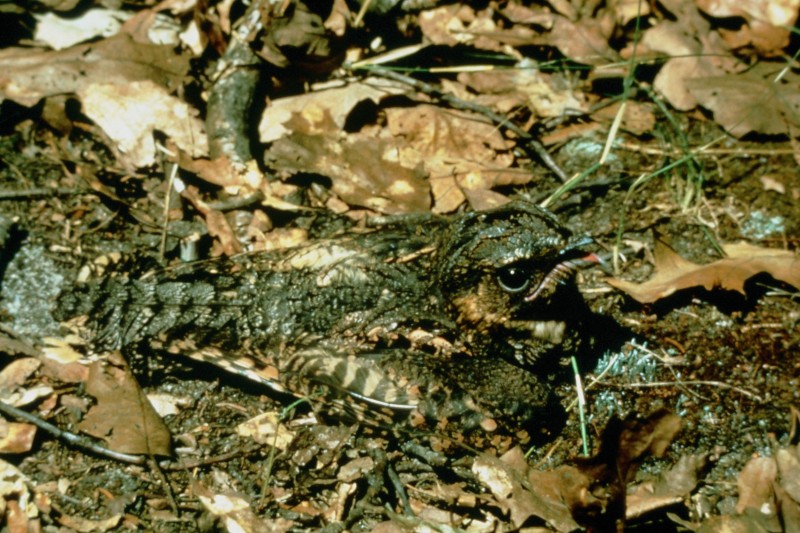
The eastern whippoorwill (Antrostomus vociferus)'s song has always been one of my favorites. Click on the arrow below to hear its call, an evocation of summer evenings when all is still. (Many thanks to the site Xeno-canto for making this possible).
Whipporwills, like many nighjars, are masters of camouflage.
One of H. P. Lovecraft's most famous stories, The Dunwich horror, mentions (and makes use of) a New England legend according to which whippoorwills can catch the departing souls of people who have just died. Considering these birds manage to catch flying insects at night, perhaps that's not such a difficult thing to do! (I wonder if the souls end up in bird droppings, though. What an inglorious end)!
Monday, 5 May 2014

Thursday, 20 March 2014
A rose by any other name

Supplementary material
There is no firm rule when it comes to naming a new gene, a new protein or a new mutation. Some names are resolutely minimalist and flatly descriptive, as with one of the most important proteins involved in the control of cell proliferation: p53 simply means "Protein, 53 kilodaltons". Way to go guys! How are we to shake off the scientist's public image of a boring stiff if we keep giving such names to things?
Luckily, we also have plenty of names involving a little more imagination. Somehow, for historical reasons, it is particularly true for genes involved in development. Some of the earliest genes studied in this field caused malformations when they were mutated, and the gene was given a name describing said mutation: hedgehog, for example, when it was mutated, caused spikes to appear on the cuticle of the drosophila embryo. A mutant daughterless gene would interfere with follicular development, resulting in all-male offsprings. And the habit caught on, with fanciful names like gürken or knirps (pickle and umbrella in German, describing the shape of the embryo), decapentaplegic, sex-combs reduced, pumillio, cactus, scylla and charybde and many, many more.
When the mammalian homolog of hedgehog was identified, it was called Sonic hedgehog, a reference to a video game character. Pikachurin was named after the Pokémon character, but an actual gene first called Pokémon (for "POK erythroid myeloid ontogenic factor", a fine case of reverse-engineering of acronyms) suffered a name-change when the owners of the Pokémon trademark protested that their property's name was associated with a cancer-causing gene. It is now called ZBTB7A
Before we give the impression that scientists are either beige and unimaginative stiffs or wild video game addicts, let us mention the genes tudor, valois, staufen and vasa, named after four European royal lines that ended for lack of descendants; these four genes are involved in fertility and their mutation makes a drosophila sterile. Yes, scientists love general culture as well!
Some names are very descriptive and give a little more info than just "p53". BRCA1, for example, stands for "Breast cancer gene 1"; TICAM2 stands for TIR domain-containing adaptor molecule 2. As you can see, acronyms or quasi-acronyms are used to make unmanageably long names a bit easier to pronounce. But how does one choose to pronounce BRCA1? Do you go "Bee-Arr-Cee-Ay-One" or "Brecca One" or even "Barca One" if you have Carthaginian blood? Here again there is no fixed rule. The Autonomous Replication Sequence (ARS) is pronounced Ay-Arr-Ess wherever "arse" is considered a bad word. Tradition and usage will usually decide how an acronym is pronounced; a bit as with YHWH, really, which has given us Yahweh or Jehovah, depending on which vowels one decides to add. (Ancient Hebrew texts, where short vowels were not written down, might indicate where such a vowel should be introduced by adding dots in certain spots, but since everyone knew how to pronounce YHWH, more precision was not needed.)
Tuesday, 11 March 2014
Jargon

Supplementary material
The epiploon (or greater omentum) is a large fold of the peritoneum that extends down, apron-like, over the intestines.
Wednesday, 26 February 2014

Friday, 7 February 2014

Thursday, 19 December 2013

Tuesday, 26 November 2013


Friday, 22 November 2013

Friday, 18 October 2013

Friday, 11 October 2013

Friday, 12 July 2013

Thursday, 11 July 2013

Friday, 31 May 2013

Subscribe to:
Posts (Atom)